
Blower Working Principle
Our Product Range
Explore our engineered solutions designed to meet the toughest industrial demands.
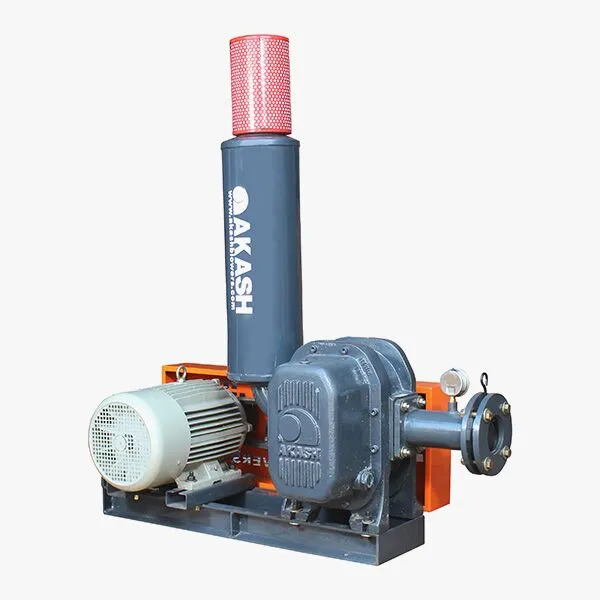
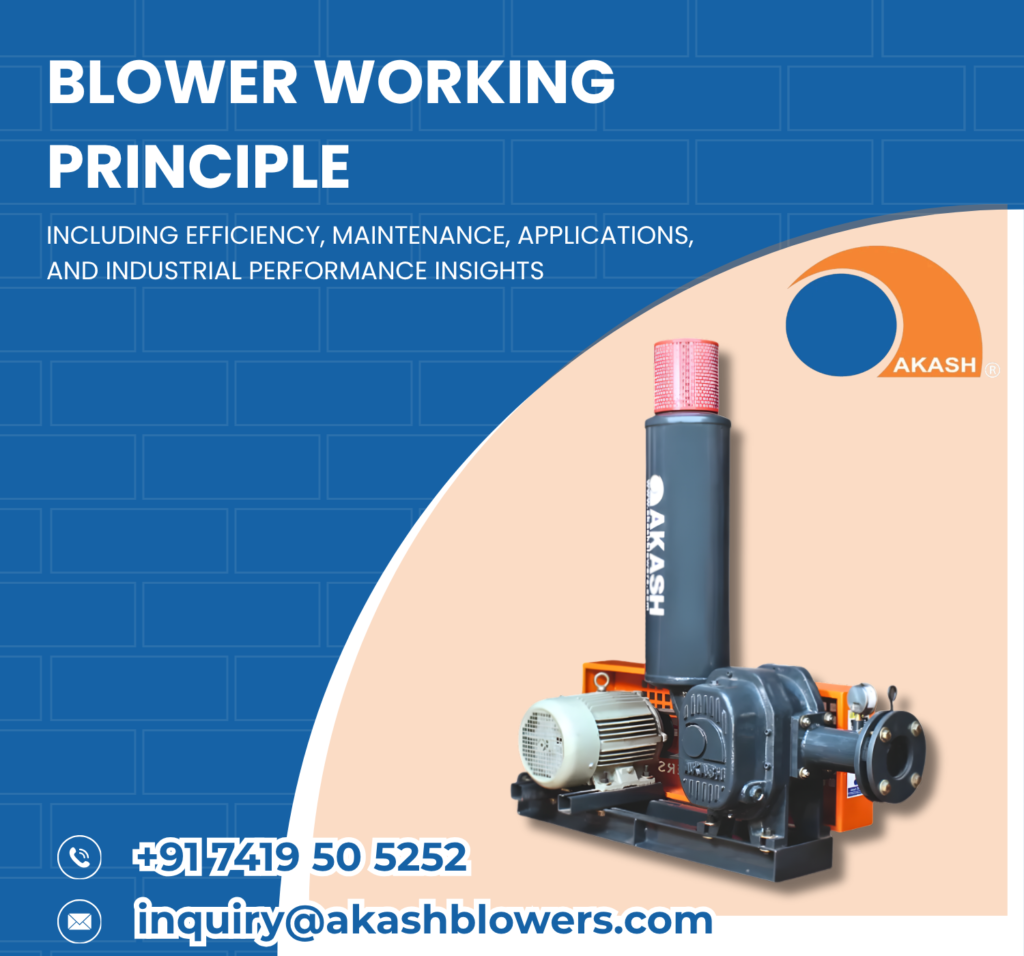
Twin Lobe Roots Blowers
Twin Lobe Roots Blowers are highly reliable and durable positive displacement units, whose pumping capacity is determined by size, operating speed, and pressure conditions.
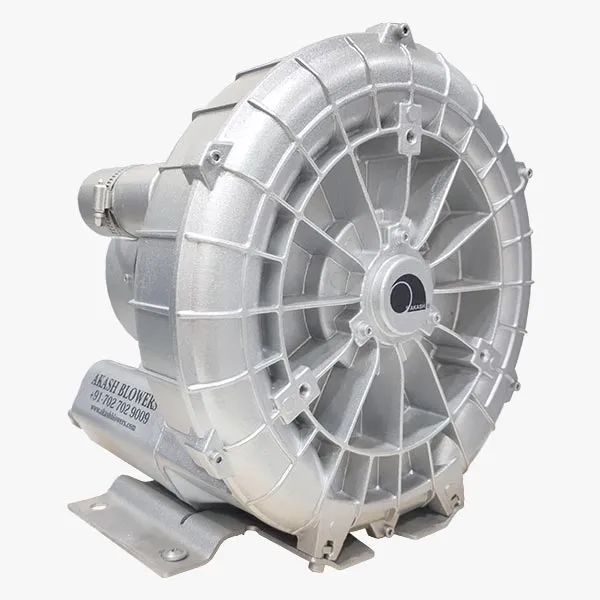
Ring/Side Channel Blowers
Ring/Side Channel Blowers feature spiral airflow, multiple air compression, and pulsation-free delivery, ensuring reliable, efficient, and high-performance industrial air supply.
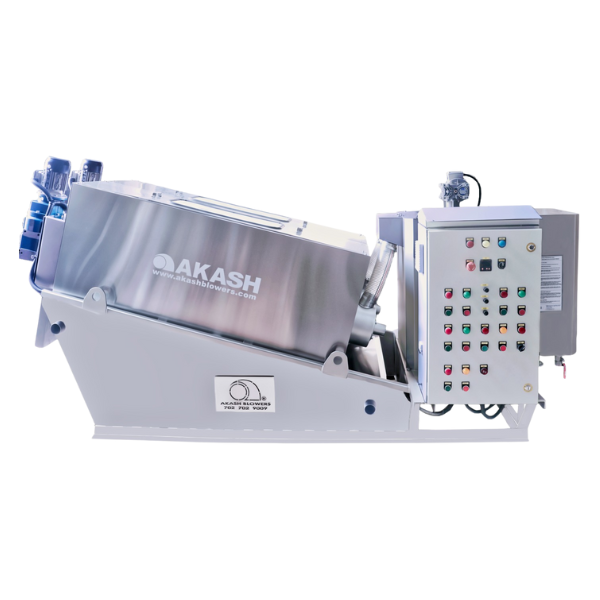
Sludge Dewatering Machine
AKASH Sludge Dewatering Machines separate solids from liquids, reducing sludge volume, lowering costs, and ensuring reliable wastewater management for industries.
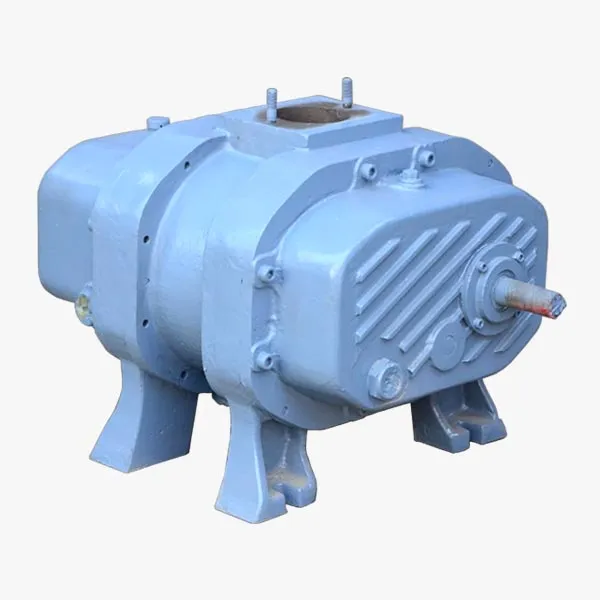
Gas Blowers
Gas Blowers are highly reliable positive displacement units designed to handle various industrial gases, with performance depending on size, speed, and pressure conditions.
overview
Blower Working Principle: Complete Guide to How Industrial Blowers Work
Understanding the blower working principle is essential for selecting, operating, and maintaining the right air-moving equipment for industrial applications. Blowers are widely used wherever a controlled flow of air or gas is required, including wastewater treatment, pneumatic conveying, chemical processing, cement production, food processing, power generation, and manufacturing.
At its core, the blower working principle involves moving air or gas from one location to another by creating a pressure difference. Depending on the blower design, this can be achieved through positive displacement or dynamic operating methods. Among industrial equipment, Roots blowers are particularly important because of their simple construction, reliable operation, and ability to provide a steady flow of air.
This guide explains what is blower, how different blower technologies operate, the Roots blower working principle, industrial applications, technical considerations, advantages, limitations, and best practices. It also explains how does blower work in practical industrial environments and what factors should be considered when selecting a suitable system.
What Is a Blower?
A blower is a mechanical device designed to move air, gases, or other compatible gaseous media while generating a pressure increase. Unlike a basic fan, which is generally designed for high-volume air movement at relatively low pressure, an industrial blower is commonly engineered to produce higher pressure and controlled airflow.
The blower working principle varies according to the blower’s construction. Some blowers trap and transport a defined volume of air, while others continuously accelerate air using rotating components and then convert velocity into pressure.
A typical industrial blower consists of a housing, rotating assembly, drive mechanism, inlet, outlet, bearings, seals, and supporting components. Depending on the application, the system may also include inlet filters, silencers, check valves, pressure-relief devices, instrumentation, and control equipment.
The main purpose is simple: generate the required airflow and pressure consistently while maintaining operational reliability.
Understanding the Blower Working Principle
The basic blower working principle is based on creating a pressure difference between the inlet and outlet. Air enters the blower through the suction side. Internal components then transfer mechanical energy to the air. The air is subsequently discharged at a higher pressure through the outlet.
However, the exact process depends on blower technology.
In a positive displacement blower, a specific quantity of air is captured and moved from the inlet toward the discharge side during each operating cycle. In a dynamic blower, rotating elements continuously accelerate the air, and the resulting velocity is converted into pressure.
This difference is important because the blower type directly influences airflow characteristics, pressure capability, efficiency, pulsation, control method, and application suitability.
For industrial users, understanding the industrial blower working principle is not simply a technical exercise. It helps determine whether a machine will deliver stable performance under actual operating conditions.
How Does a Blower Work?
So, how does blower work in a real industrial installation?
The process begins when atmospheric or process air enters through the inlet. An electric motor or another prime mover supplies mechanical energy to the blower shaft. The rotating components then interact with the incoming air and transfer energy to it.
In a positive displacement design, the rotating elements create enclosed spaces that carry air from the suction side to the discharge side. As more air is continuously transported, pressure develops in the downstream system.
In a dynamic design, the rotating impeller accelerates air to a high velocity. The blower housing or diffuser then converts part of that velocity into static pressure.
The discharge pressure is not created because the blower simply “compresses” air inside an isolated chamber. Instead, the blower generates flow and pressure according to its geometry and the resistance presented by the downstream system.
This is why the actual operating point depends on both the blower and the system connected to it.
For example, if a wastewater treatment plant requires air for aeration, the blower must overcome the resistance created by the piping, valves, diffusers, liquid depth, and other components. The blower working principle remains the same, but the required operating conditions change according to the system.
Main Types of Industrial Blowers
Industrial blowers can be broadly divided into positive displacement blowers and dynamic blowers. Each category has different operating characteristics.
Positive Displacement Blowers
Positive displacement blowers move air by repeatedly trapping and transporting a defined volume from the inlet to the discharge side.
These machines are useful when a relatively stable airflow is required over a range of operating pressures. Roots blowers are one of the most recognized examples.
The airflow is primarily determined by blower displacement and rotational speed, while actual delivered flow can be affected by internal leakage, operating pressure, temperature, and system conditions.
Positive displacement technology is particularly useful for applications requiring dependable airflow at moderate pressure levels.
Dynamic Blowers
Dynamic blowers use rotating impellers or similar aerodynamic components to transfer energy to the air.
Instead of mechanically trapping a fixed volume during each cycle, these machines continuously accelerate the gas. The air’s velocity is subsequently converted into pressure.
Dynamic blowers can be suitable for applications requiring large air volumes and specific pressure characteristics. Their performance is strongly influenced by system resistance and operating point.
Centrifugal Blowers
A centrifugal blower uses an impeller rotating at high speed. Air enters near the center of the impeller and is accelerated outward by centrifugal action.
The blower casing then guides the high-velocity air toward the outlet while converting a portion of the kinetic energy into pressure.
Centrifugal blowers are frequently used in ventilation, combustion-air systems, industrial exhaust, cooling, and process-air applications.
Roots Blowers
Roots blowers are positive displacement machines that use two synchronized rotors inside a specially shaped housing. The rotors rotate in opposite directions and move air from the inlet toward the outlet.
The Roots blower working principle is relatively straightforward, which is one reason this technology is widely used in industrial applications.
The rotors generally do not touch each other or the housing during normal operation. Precise timing is maintained through gears, allowing the rotors to rotate with very small clearances.
Our Roots Blowers
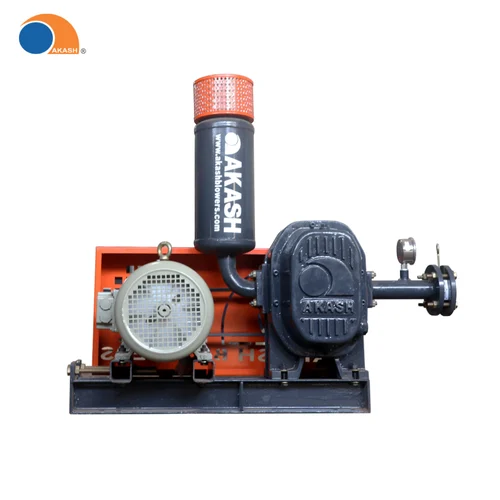
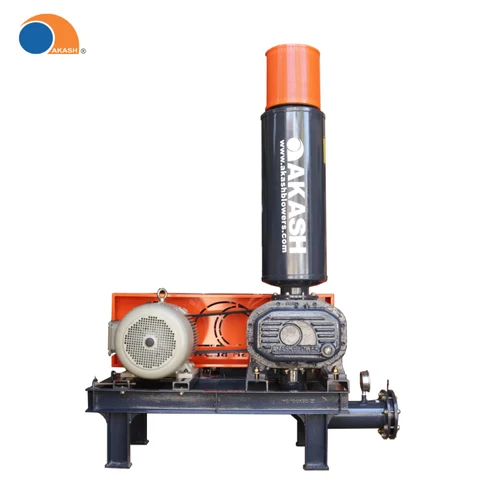
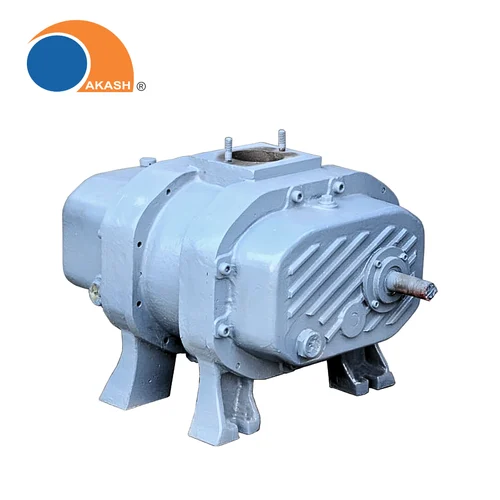
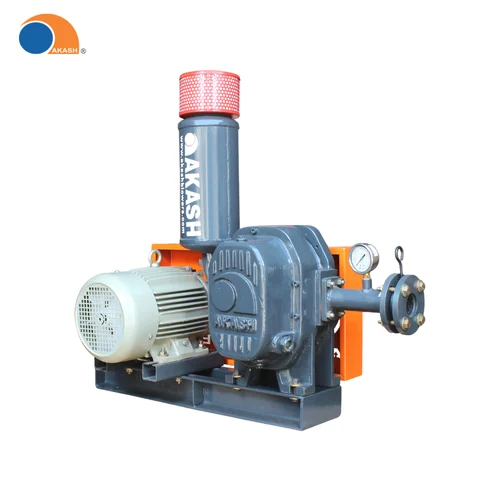
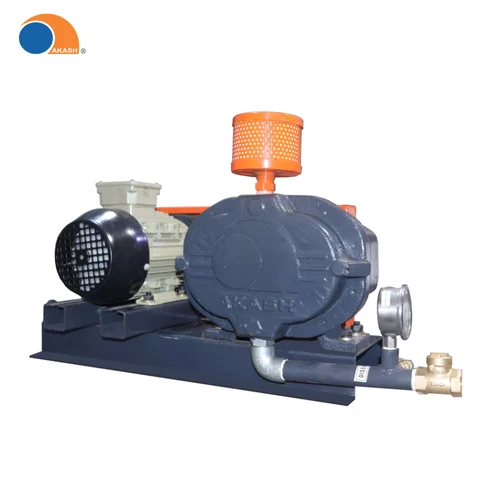
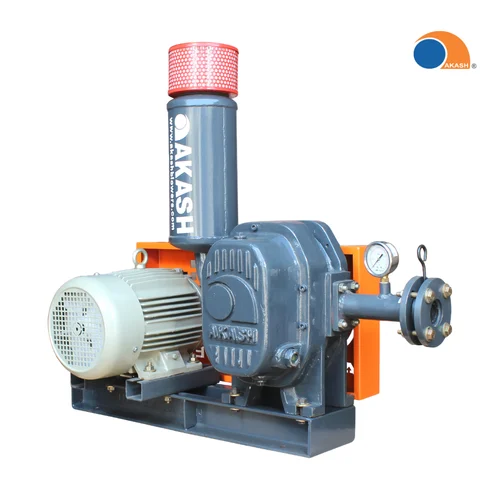
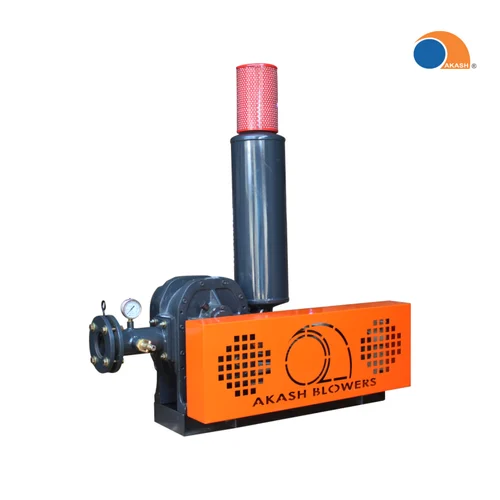
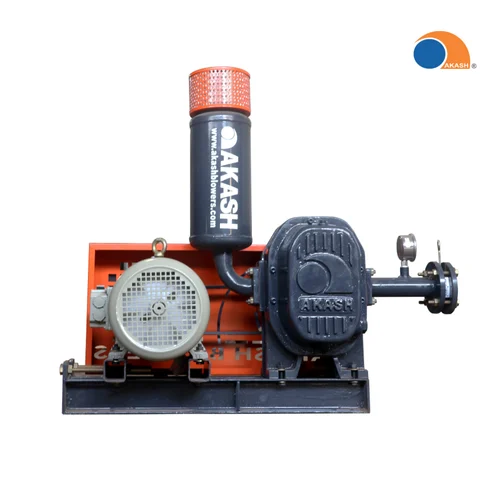
Roots Blower Working Principle Explained
The Roots blower working principle begins when air enters the inlet port as the rotor lobes create a low-pressure region.
As the rotors turn, air becomes trapped between the rotor profile and the blower casing. This trapped volume is carried around the housing toward the discharge side.
When the trapped air reaches the outlet region, it encounters the pressure already existing in the discharge system. The incoming air then enters the discharge region, causing the transported air to move into the downstream system.
A key characteristic of a conventional Roots blower is that it does not rely on internal compression in the same manner as a screw compressor. Instead, the blower transports air and develops pressure primarily because the discharge system resists the flow.
This distinction is important when understanding the Roots blower working principle.
The rotors must remain synchronized throughout operation. Timing gears prevent the lobes from contacting one another. Bearings support the shafts, while seals help separate the process side from the lubrication areas.
Because the internal clearances are carefully controlled, correct alignment, lubrication, operating temperature, and maintenance are essential for reliable operation.
Major Components Involved in Blower Operation
Understanding the major components makes the blower working principle easier to visualize.
Rotors or Impeller
The rotating element is responsible for transferring mechanical energy to the air. In a Roots blower, specially shaped lobes transport air through the casing. In a centrifugal blower, the impeller accelerates air outward.
Casing
The casing surrounds the rotating components and creates the flow passage. Its internal geometry is critical because it affects airflow, pressure development, efficiency, noise, and internal clearances.
Drive Motor
The motor supplies the mechanical power required to rotate the blower. Motor selection depends on airflow, pressure, speed, operating conditions, and duty requirements.
Bearings
Bearings support the rotating shaft and maintain correct rotor positioning. Proper bearing condition is critical because excessive wear or misalignment can affect clearances and machine reliability.
Timing Gears
Timing gears are especially important in Roots blowers. They synchronize the two rotors so that they rotate correctly without contacting one another.
Inlet Filter
The inlet filter prevents dust and unwanted particles from entering the blower. Clean inlet air is important because contamination can increase wear and reduce performance.
Silencers
Blower systems can generate considerable aerodynamic and mechanical noise. Inlet and discharge silencers help control sound and pulsation.
Pressure Relief System
Positive displacement blowers should generally operate with appropriate pressure protection. A relief arrangement can help protect the equipment when the discharge system becomes restricted.
Industrial Blower Working Principle in Different Applications
The industrial blower working principle becomes especially valuable when air or gas must be supplied continuously and reliably.
Wastewater Treatment
Wastewater treatment plants use blowers extensively for biological aeration. Air is supplied through submerged diffusers, providing oxygen to microorganisms involved in biological treatment.
Roots blowers are commonly considered for such applications because they can provide continuous airflow and operate against the pressure associated with liquid depth and diffuser resistance.
The blower must be correctly selected according to required airflow, discharge pressure, altitude, temperature, and process conditions.
Pneumatic Conveying
Blowers can move bulk materials through pipelines using controlled airflow.
In dilute-phase pneumatic conveying, air velocity keeps particles suspended and transports them through the conveying line. The blower must overcome pipeline resistance, bends, filters, material loading, and other pressure losses.
The correct blower working principle and operating point are therefore important for preventing blockages and maintaining stable material movement.
Chemical Processing
Chemical plants may require process air, gas circulation, stripping air, ventilation, or other controlled gas movement.
In these environments, blower construction and material compatibility become particularly important. The selected blower should be appropriate for the process gas, temperature, pressure, and contamination level.
Cement and Mineral Industries
Industrial blowers are used in combustion systems, pneumatic transport, cooling, aeration, dust collection, and process-air applications.
These environments can expose equipment to abrasive dust and high temperatures. Filtration, sealing, cooling, and preventive maintenance therefore become essential.
Food and Pharmaceutical Industries
Blowers may be used for pneumatic conveying, drying, aeration, vacuum systems, packaging, and process handling.
Where product contamination is a concern, the blower configuration and air quality requirements need to be carefully evaluated. Filtration and hygienic system design can be important parts of the overall installation.
Comparison of Common Blower Technologies
| Feature | Roots Blower | Centrifugal Blower | Screw Blower |
|---|---|---|---|
|
Operating principle |
Positive displacement |
Dynamic |
Positive displacement |
|
Airflow characteristic |
Relatively stable displacement-based flow |
Strongly influenced by operating point |
Continuous displacement-based flow |
|
Pressure capability |
Suitable for many moderate-pressure industrial duties |
Suitable for selected pressure and high-flow duties |
Suitable for efficient compressed-air and process applications |
|
Flow control |
Speed control, bypass, or other control methods |
Speed, inlet, or system control |
Speed and control-system dependent |
|
Construction |
Mechanically straightforward |
Aerodynamic rotating assembly |
Precision rotor arrangement |
|
Maintenance |
Requires attention to bearings, gears, seals, filtration, and lubrication |
Requires attention to impeller, bearings, vibration, and aerodynamic condition |
Requires precision maintenance and lubrication |
|
Application flexibility |
Strong for continuous industrial airflow |
Strong for high-volume applications |
Strong for efficiency-focused applications |
|
Pulsation |
Can require pulsation control |
Generally smoother flow |
Generally smooth flow |
|
Scalability |
Available for a wide range of industrial duties |
Highly scalable for large airflow requirements |
Scalable for process and compressed-air applications |
Advantages of Understanding the Blower Working Principle
A strong understanding of the blower working principle helps users make better equipment decisions.
First, it allows engineers to select the correct blower technology rather than choosing equipment based only on airflow requirements. Airflow and pressure must be considered together.
Second, understanding the operating principle makes troubleshooting easier. Unusual pressure, reduced airflow, overheating, abnormal vibration, and unusual noise can often be connected to specific mechanical or system-related issues.
Third, understanding blower operation supports better energy management. A blower operating far away from its intended duty point can waste energy and experience unnecessary stress.
Finally, technical knowledge improves maintenance planning. Operators who understand how the machine functions are more likely to recognize early warning signs before they become serious failures.
Blower Performance: Airflow and Pressure
Two of the most important parameters in blower selection are airflow and pressure.
Airflow indicates the quantity of gas the blower moves over a particular period. Pressure indicates the resistance or pressure difference that the blower can overcome.
These two parameters should never be evaluated independently.
Suppose an industrial system requires a specific airflow at a particular discharge pressure. A blower that provides the required airflow at low pressure may fail to meet the actual operating requirement once connected to the system.
Likewise, selecting a machine for unnecessarily high pressure capability can result in inefficient operation.
A proper selection process therefore considers the complete system curve, including pipe losses, fittings, filters, valves, diffusers, elevation changes, and process resistance.
Factors That Influence Blower Performance
Several variables influence the actual performance of an industrial blower.
Operating Pressure
As discharge pressure increases, blower power requirements generally increase. The machine must be selected according to the actual pressure requirement rather than an assumed value.
Air Temperature
Temperature affects air density and can influence mass flow, volumetric flow, cooling requirements, and blower performance.
Altitude
At higher elevations, atmospheric pressure and air density differ from standard sea-level conditions. This can influence blower selection and motor requirements.
Speed
Rotational speed directly affects blower performance. Increasing speed can increase airflow, but it can also increase power consumption, temperature, vibration, and mechanical stress.
System Resistance
The downstream piping and equipment determine how difficult it is for air to move through the system. A blower should be evaluated against the complete system rather than as an isolated machine.
Air Quality
Dust, moisture, corrosive gases, and other contaminants can affect internal components and filtration requirements.
Roots Blower vs Centrifugal Blower
The difference between a Roots blower and a centrifugal blower is primarily based on how air is moved.
A Roots blower uses positive displacement. The rotating lobes transport air through the casing. This makes the technology particularly useful where relatively predictable airflow is required against varying pressure conditions.
A centrifugal blower accelerates air using an impeller. Its performance is strongly connected to the system operating point.
For applications such as aeration, pneumatic conveying, and certain process-air duties, a Roots blower can provide the required operating characteristics. For very high-volume air movement and specific aerodynamic requirements, centrifugal technology may be more suitable.
The correct decision should always be based on engineering requirements rather than technology preference alone.
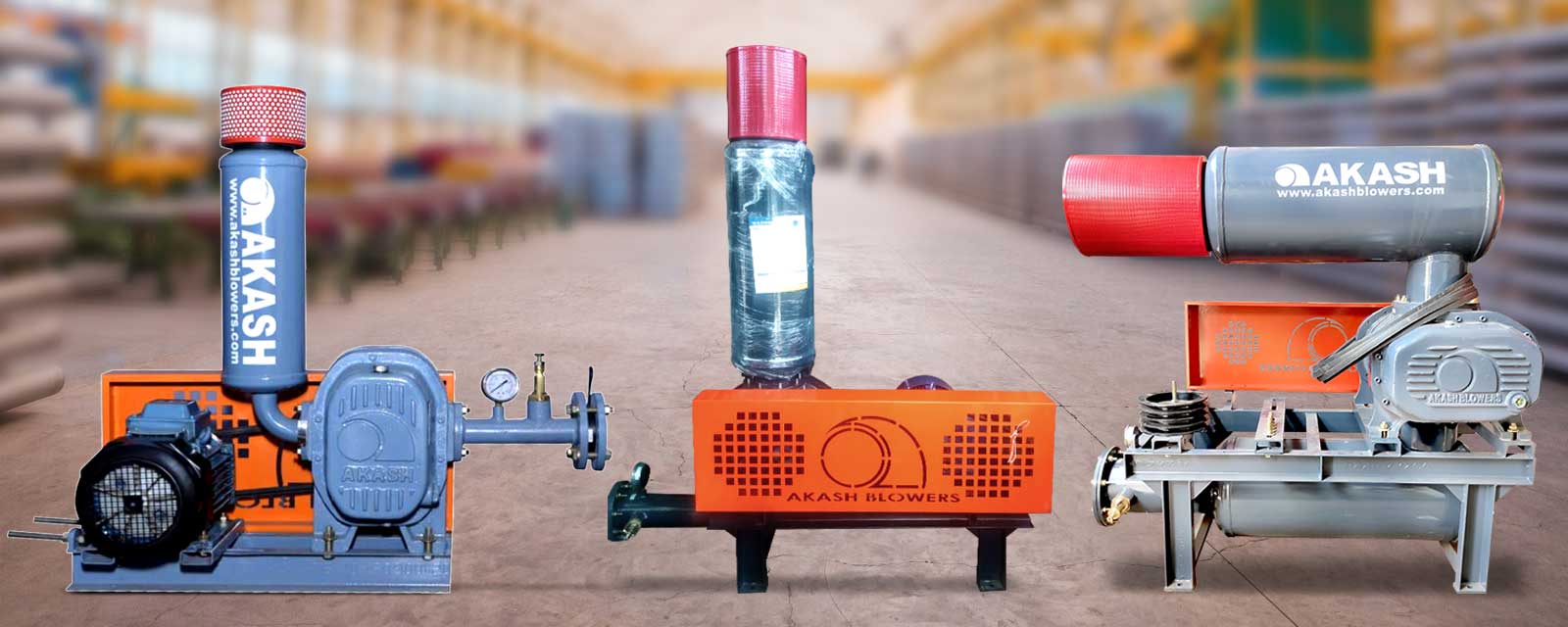
Technical Considerations When Selecting a Blower
Selecting an industrial blower requires more than matching a catalogue airflow number.
The first consideration should be the required operating airflow. This should represent actual process demand rather than a rough estimate.
Next, determine the required discharge pressure. The calculation should include all downstream losses.
Gas composition is another important factor. Air, oxygen-enriched gases, inert gases, corrosive gases, and process gases can require different materials and sealing arrangements.
Operating temperature should also be considered because temperature affects density, cooling, lubrication, and component life.
Duty cycle matters as well. A blower running continuously under demanding conditions requires different considerations from equipment used intermittently.
Finally, consider controls. Modern systems may use variable-frequency drives, sensors, automated pressure control, and process monitoring to improve operational flexibility.
Common Blower Problems and Practical Solutions
Even a properly selected blower can experience performance problems if installation and maintenance are neglected.
Reduced Airflow
Reduced airflow may result from a blocked inlet filter, incorrect rotation, excessive system resistance, worn internal components, or operating conditions outside the intended range.
The first step should be to check the inlet and discharge conditions. Filters should be inspected, valves verified, and pressure readings compared with normal operating values.
Excessive Noise
Noise can result from aerodynamic pulsation, mechanical wear, insufficient lubrication, loose components, or unsuitable installation.
A structured inspection should identify whether the noise is mechanical or airflow-related.
Excessive Temperature
Overheating may be associated with excessive pressure, insufficient cooling, incorrect lubrication, bearing problems, restricted airflow, or unsuitable operating conditions.
Operating a blower continuously at an abnormal pressure should be avoided because heat generation can significantly affect component life.
High Vibration
Vibration can indicate misalignment, bearing deterioration, rotor imbalance, foundation problems, coupling issues, or mechanical damage.
Ignoring vibration is risky because small mechanical problems can become major failures.
Pressure Instability
Pressure fluctuations can occur because of system restrictions, incorrect control settings, pulsation, process changes, or unsuitable blower selection.
The blower and connected system should be evaluated together to identify the actual cause.
Best Practices for Efficient Blower Operation
Efficient blower operation begins with proper system design. The blower should be selected around the actual duty point, including required airflow and pressure.
Avoid unnecessary restrictions in the suction and discharge lines. Poorly designed piping can increase pressure losses and force the blower to work harder.
Keep inlet filters clean. A restricted filter can reduce airflow while increasing the load on the system.
Maintain correct lubrication according to the manufacturer’s requirements. Both insufficient and excessive lubrication can create problems.
Monitor operating parameters regularly. Pressure, temperature, vibration, motor load, and airflow can provide useful indicators of machine health.
Variable-speed control can also be useful when process demand changes significantly. Instead of continuously operating at maximum speed and throttling the system, speed control can allow the blower output to better match actual demand.
Maintenance of Industrial Blowers
Preventive maintenance is critical for long-term blower reliability.
A maintenance program should include regular inspection of filters, bearings, lubrication systems, belts or couplings, seals, valves, silencers, and electrical components.
For Roots blowers, timing gears and rotor clearances require particular attention. Proper lubrication and alignment help protect the rotating assembly.
Operators should also establish baseline operating values. When temperature, vibration, pressure, or motor load begins to move away from the normal range, the change can be investigated before failure occurs.
Condition monitoring can further improve reliability in critical installations.
Instead of waiting for a breakdown, industrial users can use scheduled inspections and performance tracking to identify deterioration early.
How to Improve Blower Efficiency
Improving efficiency does not always require replacing the blower. Often, system-level improvements can deliver significant operational benefits.
Start by checking whether the blower is operating close to its intended duty point. Excessive throttling or unnecessary pressure can increase energy consumption.
Inspect the entire air-distribution network. Leaks, unnecessary bends, undersized piping, blocked filters, and excessive restrictions can increase system resistance.
Automation can also help. If airflow demand varies throughout the day, variable-speed operation or intelligent sequencing can prevent multiple blowers from operating unnecessarily.
Regular maintenance is equally important. A dirty filter, worn bearing, poor alignment, or damaged component can gradually reduce overall efficiency.
Common Mistakes to Avoid When Choosing a Blower
One of the most common mistakes is selecting equipment based only on airflow. A blower must be selected according to airflow and pressure.
Another mistake is ignoring actual site conditions. Temperature, altitude, humidity, gas composition, and contamination can all affect performance.
Users sometimes also overlook future capacity requirements. If the production process is expected to expand, the blower system should be evaluated for scalability.
Another frequent issue is underestimating the importance of filtration. Contaminated air can reduce reliability and increase maintenance requirements.
Finally, choosing a blower without considering the entire system can lead to poor performance. The blower is only one component of an air-handling system.
Why Choose Akash Blowers?
Selecting the right manufacturer or supplier is as important as selecting the correct blower technology. Akash Blowers focuses on industrial blower solutions designed around practical operating requirements and application-specific needs.
A reliable blower partner should understand that every installation is different. Airflow requirements, pressure conditions, operating schedules, environmental factors, and process demands all influence equipment selection.
Akash Blowers can be considered by industries looking for application-focused blower solutions, dependable engineering, and equipment designed for industrial operating environments.
The value of working with an experienced blower company goes beyond the machine itself. Proper application understanding can help users avoid incorrect selection, unsuitable operating conditions, inefficient system design, and avoidable maintenance problems.
For businesses planning a new installation or upgrading an existing air system, selecting equipment with long-term reliability and scalability in mind can support better operational performance.
Practical Example of Blower Selection
Consider a wastewater treatment facility that needs continuous air for biological aeration.
The first step is to determine the required airflow based on the treatment process. Next, the engineering team calculates the pressure required to overcome liquid depth, diffuser resistance, piping losses, valves, and other components.
The blower is then selected based on the actual operating point rather than simply choosing the largest available machine.
If the plant experiences changing oxygen demand, a variable-speed control strategy or multiple-blower arrangement may provide better flexibility.
The installation should also include suitable filtration, silencers, pressure protection, monitoring instruments, and maintenance access.
This example demonstrates why understanding the blower working principle is important. Equipment selection is not simply about purchasing a machine that moves air. It is about matching the machine’s operating characteristics to the process.
Blower Working Principle: Positive Displacement vs Dynamic Operation
The distinction between positive displacement and dynamic operation is one of the most important concepts in industrial blower engineering.
Positive displacement blowers transport defined volumes of gas. Their output is closely related to displacement and rotational speed, although actual delivered flow can be influenced by leakage and operating conditions.
Dynamic blowers transfer energy continuously through rotating aerodynamic components. Their pressure and airflow relationship is more strongly dependent on the system operating point.
Neither principle is universally better.
The correct technology depends on the process. A wastewater aeration system, pneumatic conveying application, industrial ventilation system, and process-gas application may each require a different solution.
Understanding this difference allows engineers to make decisions based on technical requirements instead of simply comparing equipment names.
Future of Industrial Blower Systems
The future of industrial blower systems is likely to focus increasingly on efficiency, automation, monitoring, and system integration.
Connected sensors can provide continuous information about machine condition. Intelligent controllers can adjust blower operation according to process demand. Multiple blowers can be sequenced automatically to maintain the required airflow while avoiding unnecessary operation.
Energy efficiency will remain an important consideration as industries seek to reduce resource consumption and improve overall process performance.
Another important trend is system-level optimization. Instead of evaluating only the blower, modern engineering approaches consider the complete airflow network, including piping, valves, filters, diffusers, controls, and end-use equipment.
This holistic approach can improve reliability and operational efficiency.
Final Checklist for Better Blower Performance
Before installing or upgrading an industrial blower, consider the following:
- Define actual airflow requirements: Determine the process airflow requirement under normal, minimum, and maximum operating conditions rather than relying on a single estimated value.
- Calculate system pressure correctly: Include piping losses, filters, valves, diffusers, fittings, elevation, and process resistance when establishing the required discharge pressure.
- Select the appropriate blower technology: Compare positive displacement and dynamic designs according to the actual application instead of assuming one technology is suitable for every process.
- Consider operating conditions: Evaluate temperature, altitude, humidity, gas composition, contamination, and duty cycle before finalizing equipment selection.
- Plan for control and scalability: Consider variable-speed operation, automatic sequencing, monitoring, and future process expansion when designing the system.
- Establish a maintenance strategy: Include routine inspection, filtration, lubrication, vibration monitoring, alignment checks, and performance evaluation to protect long-term reliability.
Conclusion
The blower working principle is fundamentally based on transferring mechanical energy to air or gas and creating the pressure difference needed to move it through an industrial system. However, the exact method depends on the blower technology.
Understanding how does blower work, the difference between positive displacement and dynamic designs, and the Roots blower working principle allows engineers and plant operators to make better equipment decisions.
Roots blowers are particularly valuable in applications where dependable and continuous airflow is required. Centrifugal and other blower technologies can offer advantages in different operating environments. The right selection therefore depends on airflow, pressure, gas characteristics, duty cycle, efficiency requirements, control strategy, and future scalability.
For businesses seeking dependable industrial air-moving equipment, Akash Blowers can be a valuable partner in evaluating application requirements and identifying suitable blower solutions. A properly selected and maintained blower can contribute to stable processes, improved operational efficiency, reliable airflow, and long-term equipment performance.
If you are planning a new blower installation, replacing existing equipment, or looking to optimize an operating air system, take the next step by evaluating your actual airflow and pressure requirements with an application-focused approach. Explore Akash Blowers and discover a blower solution designed around your industrial requirements, performance goals, reliability expectations, and long-term growth.
Frequaently Asked Question
The blower working principle is based on moving air or gas from an inlet to an outlet by creating a pressure difference. Mechanical energy from a motor rotates internal components, which transfer energy to the air. Depending on the blower type, air may be positively displaced or dynamically accelerated before being discharged into the connected system.
A blower draws air through its inlet and transfers mechanical energy to the air through rotating components. The air is then discharged at a higher pressure. How does blower work depends on its design. Roots blowers use positive displacement, while centrifugal blowers use dynamic air acceleration.
Industrial blowers are used wherever controlled airflow or gas movement is required. Common applications include wastewater aeration, pneumatic conveying, combustion air supply, industrial ventilation, cooling, drying, chemical processing, cement plants, food processing, and various manufacturing operations.
The Roots blower working principle is based on positive displacement. Two synchronized rotors rotate inside a specially designed housing. As the rotors turn, they trap air at the inlet and carry it around the casing toward the discharge side. The air is then forced into the connected system.
A conventional Roots blower primarily transports and displaces air rather than internally compressing it like a screw compressor. Pressure develops when the displaced air encounters resistance from the downstream system. This is an important characteristic of the Roots blower working principle.
The major categories include positive displacement blowers and dynamic blowers. Roots blowers and screw blowers fall under positive displacement technology, while centrifugal blowers operate using dynamic principles. The appropriate type depends on airflow, pressure, operating conditions, and application requirements.
A blower is generally designed to generate a higher pressure increase than a conventional fan while maintaining controlled airflow. Fans are commonly used for ventilation and cooling, whereas industrial blowers are frequently selected for applications involving greater system resistance and process-air requirements.
The industrial blower working principle involves transferring mechanical energy from a motor or drive system to air or gas. The blower generates airflow and pressure according to its internal design and the resistance of the connected process system. Different industrial blower technologies achieve this through different mechanisms.
Roots blowers are widely used in wastewater treatment, pneumatic conveying, aeration, industrial process systems, combustion-air applications, and other operations requiring reliable continuous airflow. Their positive displacement characteristics make them suitable for applications where consistent air delivery is important.
Blower performance can be affected by airflow demand, discharge pressure, rotational speed, air temperature, altitude, gas density, inlet restrictions, piping resistance, filtration, and system configuration. Properly evaluating these factors helps ensure that the blower operates near its intended duty point.
Blower pressure represents the resistance that the machine must overcome to deliver air through the system. Piping, valves, filters, diffusers, bends, and process equipment can all contribute to pressure losses. Therefore, pressure requirements should be calculated from the complete system rather than estimated independently.
Blower efficiency can be improved through correct equipment selection, proper system design, clean inlet filters, reduced unnecessary pressure losses, appropriate speed control, leak prevention, regular maintenance, and proper operating conditions. Monitoring airflow, pressure, temperature, vibration, and motor load can also identify efficiency problems.
Excessive blower noise can result from aerodynamic pulsation, mechanical wear, bearing problems, incorrect alignment, loose components, excessive operating pressure, or inadequate acoustic control. Inlet and discharge silencers, proper installation, and regular maintenance can help reduce unwanted noise.
A blower may overheat because of excessive discharge pressure, restricted airflow, inadequate cooling, incorrect lubrication, bearing problems, high rotational speed, or operation outside its intended conditions. Regular monitoring of temperature and operating pressure can help identify overheating problems early.
Inlet filtration prevents dust, dirt, and other contaminants from entering the blower. Contaminated air can accelerate component wear, affect internal clearances, damage bearings or seals, and reduce performance. Keeping the inlet filter clean is therefore an important part of blower maintenance.
Many industrial blowers are designed for continuous-duty applications when correctly selected and operated. However, continuous operation requires suitable airflow, pressure, cooling, lubrication, filtration, and maintenance. The equipment should always be operated within the manufacturer’s specified conditions.
Roots blower maintenance generally involves inspecting lubrication, bearings, seals, timing gears, couplings, filters, vibration, temperature, and operating pressure. Maintaining correct alignment and lubrication is particularly important because the rotors operate with precisely controlled internal clearances.
Blower selection should begin with the required airflow and discharge pressure. Engineers should then evaluate temperature, altitude, gas composition, duty cycle, contamination, installation conditions, control requirements, and future capacity. Selecting a blower based only on airflow can result in unsuitable performance.
A Roots blower uses positive displacement to transport air, while a centrifugal blower uses a rotating impeller to accelerate air and convert velocity into pressure. Roots blowers can be useful for relatively stable airflow requirements, while centrifugal blowers are often suitable for high-volume applications with specific pressure-flow characteristics.
Understanding the blower working principle helps users select suitable equipment, troubleshoot performance issues, improve efficiency, plan maintenance, and operate the system safely. Knowledge of the Roots blower working principle and other blower technologies also makes it easier to match the machine with the actual requirements of an industrial process.
What Our Clients Say About Us

RATHOD VIJAY
4 months ago
- List Item #1
- List Item #1
- List Item #1
- List Item #1
- List Item #1
Verified Purchase
Akash Blowers service always excellent, deliveries always on time, staff highly technical and cooperative. Industrial Roots Blower performance great.

Jayesh Pangam
3 months ago
- List Item #1
- List Item #1
- List Item #1
- List Item #1
- List Item #1
Verified Purchase
Product quality very good and after-sales support also reliable. With 100% spare parts available, their Ring Blowers service makes the team more dependable.

Arvind Raut
3 months ago
- List Item #1
- List Item #1
- List Item #1
- List Item #1
- List Item #1
Verified Purchase
Akash Blowers Pvt Ltd makes quality Air Blowers; with 5 years of support their service stays prompt and cost-effective. Roots Blower performance always reliable.

Akshara m
4 months ago
- List Item #1
- List Item #1
- List Item #1
- List Item #1
- List Item #1
Verified Purchase
Best and timely service providers offering quick support and smooth coordination, delivering dependable Water Treatment Blower solutions for every requirement.
Aparna S
3 months ago
- List Item #1
- List Item #1
- List Item #1
- List Item #1
- List Item #1
Verified Purchase
Good staff service, quick quotes, and efficient Roots Blower performance. Client fully satisfied and issues resolved instantly. Well done Akash Blowers.

Anuj Sharma
3 months ago
- List Item #1
- List Item #1
- List Item #1
- List Item #1
- List Item #1
Verified Purchase
Good experience with Akash Products. Best service, on-time delivery and friendly staff. A trusted choice for Twin Lobe Roots Blower users.

Himmat Singh
Month ago
- List Item #1
- List Item #1
- List Item #1
- List Item #1
- List Item #1
Verified Purchase
Product quality very good, sales and service staff helpful, spare parts easy to get, and their Ring Blower support remains reliable and smooth.

Amit Yadav Yadav
3 years ago
- List Item #1
- List Item #1
- List Item #1
- List Item #1
- List Item #1
Verified Purchase
We’re associated for 5 years; models like AB-305, AB-44, AB-52 work great. Support is reliable, especially in Industrial Roots Blower solutions.

Divyanshu pandey
2 months ago
- List Item #1
- List Item #1
- List Item #1
- List Item #1
- List Item #1
Verified Purchase
I like all the work of this company. Very best 👍🏻 Best quality material and reliable Air Blower and Roots Blower products.

UNISTAR AQUATECH
2 months ago
- List Item #1
- List Item #1
- List Item #1
- List Item #1
- List Item #1
Verified Purchase
Very good experience with Akash Blower Company. Supportive team and quick response. Trusted for Water Treatment Blower solutions.

Dhanashree Jadhav
3 months ago
- List Item #1
- List Item #1
- List Item #1
- List Item #1
- List Item #1
Verified Purchase
Very nice service provided by Akash Blowers team. Reliable support for Ring Blower and other Industrial Roots Blower needs.

Pardeep Kumar
3 years ago
- List Item #1
- List Item #1
- List Item #1
- List Item #1
- List Item #1
Verified Purchase
Such a wonderful company to buy Ring Blower. Purchased 1 year ago, still works perfectly. Fully satisfied with Roots Blower support.

Sumeet bansal
2 months ago
- List Item #1
- List Item #1
- List Item #1
- List Item #1
- List Item #1
Verified Purchase
Their products and service are very good. Trusted for high-quality Air Blower and reliable Twin Lobe Roots Blower solutions.

Ewaltz works
9 months ago
- List Item #1
- List Item #1
- List Item #1
- List Item #1
- List Item #1
Verified Purchase
Akesh Blowers provides best on-time service and delivery. Technical, cooperative staff. Ideal for Roots Air Blower, Screw Press, and spares.

Saumyaranjan Nayak
10 months ago
- List Item #1
- List Item #1
- List Item #1
- List Item #1
- List Item #1
Verified Purchase
Best on-time service and delivery within 24–48 hours. Friendly, cooperative staff. Ideal for Roots Blower and Industrial Air Blower needs.

Account Amitaqua
3 months ago
- List Item #1
- List Item #1
- List Item #1
- List Item #1
- List Item #1
Verified Purchase
Good experience with Akash Products; their service is reliable, and both Air Blower and Roots Blower solutions deliver consistent high quality.

Mohit Kumar
2 months ago
- List Item #1
- List Item #1
- List Item #1
- List Item #1
- List Item #1
Verified Purchase
Good product and excellent service. Trusted for reliable Air Blower and high-quality Twin Lobe Roots Blower solutions.

Kishan Bhagat
11 months ago
- List Item #1
- List Item #1
- List Item #1
- List Item #1
- List Item #1
Verified Purchase
Company bahut achi hai. Staff bhi bahut acha hai. 3 saal se koi problem nahi hui. First-class service for Ring Blower & Roots Blower.

Harsh Sharma
10 months ago
- List Item #1
- List Item #1
- List Item #1
- List Item #1
- List Item #1
Verified Purchase
Good company nd quality of blowers so good nd service bhi too good. Ring Blower and Air Blower products are very reliable.

Sudhish Kumar
10 months ago
- List Item #1
- List Item #1
- List Item #1
- List Item #1
- List Item #1
Verified Purchase
Good experience with Akash Products. Nice design, excellent output as per requirement. Trusted for Roots Blower & Air Blower.
Review Us on Google
Take a moment to review us on Google and let us know how we’re doing. Your feedback helps us improve and continue delivering the best solutions.
Click Hereblower working principle, Roots blower working, how does blower work, what is blower, roots blower working principle, industrial blower working principle
blower working principle, Roots blower working, how does blower work, what is blower, roots blower working principle, industrial blower working principle
blower working principle, Roots blower working, how does blower work, what is blower, roots blower working principle, industrial blower working principle